
Workplace safety doesn’t start with the rules on paper, but with the employee who understands them. Safety rules are followed better when every employee knows what to do, why it matters and sees the explanation again regularly. A consistent, visual instruction in the employee’s own language, with a short knowledge check, lays the foundation for this.
What does workplace safety mean in practice?
Workplace safety covers everything you do to prevent employees from getting injured or ill at work. Think of safe machines and workstations, personal protective equipment, clear agreements and the behaviour of employees themselves. In the Netherlands, the Working Conditions Act (Arbowet) provides the basis for this. This blog is about that last part: how do you make sure the agreements are actually followed?
It’s important to know the risks on the work floor. They are listed in the risk assessment (RI&E), the safety rules have been drawn up and every new employee receives an instruction. Yet workplace safety is about what happens on the floor. Does someone wear their safety glasses when the team leader isn’t around? Does the walkway stay clear when it’s busy?
A rule on paper shows what should happen. Whether it’s actually followed, you only see on the floor.
Why safety rules aren't always followed
When a rule isn’t followed, it’s easy to assume someone simply doesn’t want to. But the cause often lies somewhere else.
Sometimes the rule hasn’t been properly understood. An employee who speaks limited Dutch nods during the explanation and signs the instruction form. That still doesn’t mean they know what is expected of them.
Sometimes someone doesn’t know why a rule exists. A rule without a reason soon feels like something you can skip when it’s busy. That’s exactly when small deviations creep in. Safety glasses pushed up on the forehead instead of covering the eyes. A shortcut past the forklifts. A machine guard left open for a moment.
Sometimes the rule has simply faded. What someone hears on their first working day, they don’t always remember a few weeks later.
Safety on the work floor with many temporary employees
With many temporary employees, new people start throughout the month, sometimes in the middle of a busy period. The safety instruction then comes from whoever happens to be there that day.
One team leader explains in detail where the danger zones are. Another mainly says: vest on and stay within the lines. So two employees who start in the same week end up with a different foundation.
But following the rules isn’t just about new people. Experienced employees deviate too, precisely because they know the work so well. "It’s always been fine" is a familiar reason to skip a step. Keeping safety rules alive is therefore something for every employee, permanent or temporary.
How to make sure safety rules are followed
Start with these five steps:
- Choose the rules that really matter
Nobody remembers a long list of rules. Use your risk assessment (RI&E) to see which tasks carry the greatest risk and start there. - Explain why for every rule
An employee who knows why a rule exists is less likely to skip it when it’s busy. Show what can happen when things go wrong. - Show how it's done, in a language the employee understands
Use visuals wherever you can. Ask which language someone prefers for instructions, not just what their nationality is. - Check understanding, not just receipt
A signature shows that someone has received the instruction. A short knowledge check or an explanation in their own words shows whether they actually understand it. - Come back to it regularly
Repeat the most important rules after an incident, when a working method changes and at fixed moments. Walk the floor yourself and set a good example.
Start with understanding, not enforcement
Reprimanding and enforcing rules are part of health and safety. But you can only reprimand someone for breaking a rule if you are sure they understand the rules.
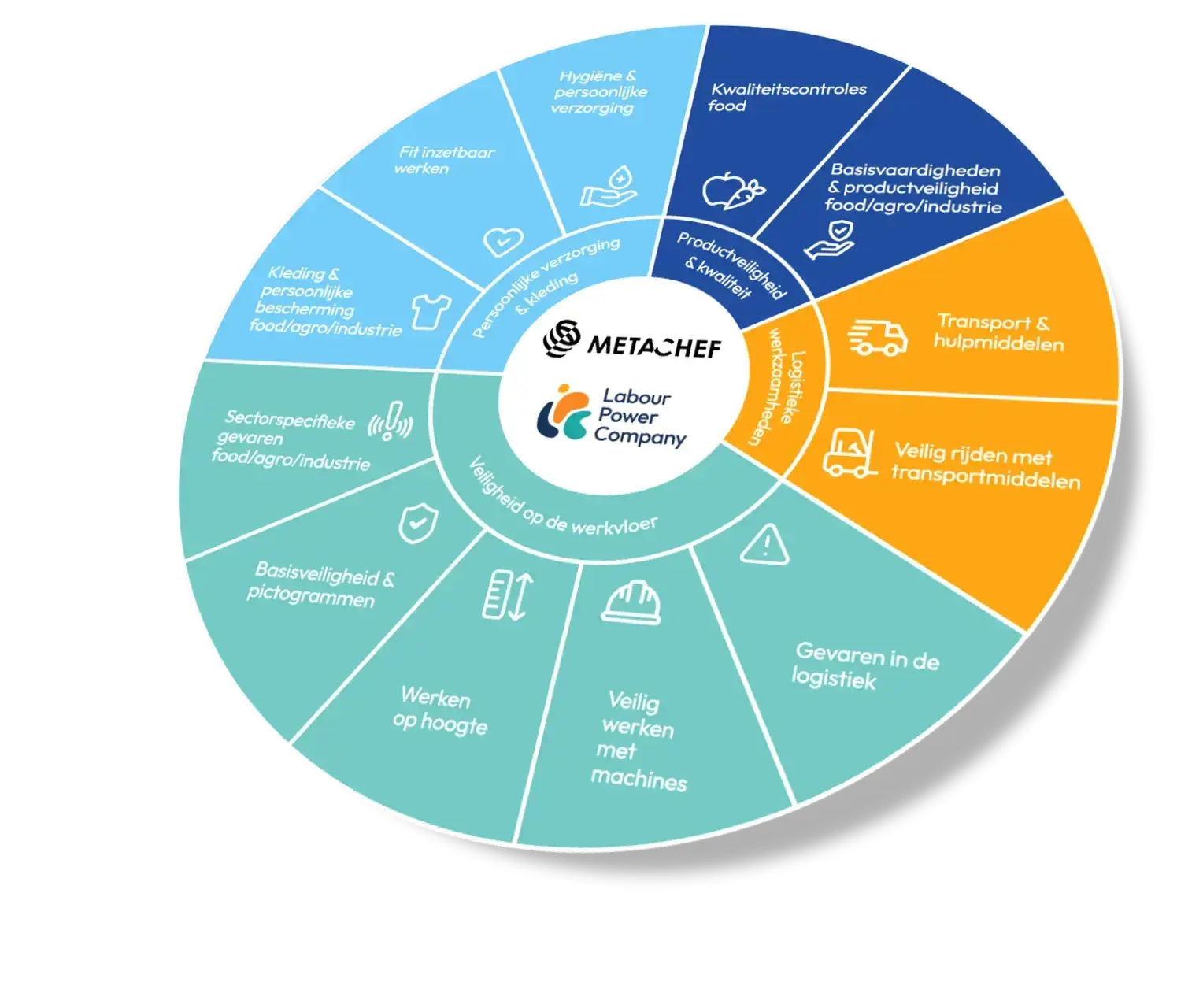
Steps 3 and 4 in particular are difficult to maintain when new employees join every week. This is where an explanation that is the same for everyone and clearly shows what needs to be done comes in handy. That is the basis of the Skillcircle: short 3D training modules for temporary and permanent staff, developed by MetaChef in collaboration with Labour Power Company.
The staff member sees the workplace in 3D, as if they were already standing right in the middle of it. They can see where forklift trucks are driving, what a pictogram on a door means and when they need to shut down a machine. By tapping on a component, they can see how it should be done and why.
A real-life example is Kobus P&O, part of LPC. Kobus works with staff from different countries and with varying levels of language proficiency. Now, before their first shift, new staff complete short 3D training sessions on their own phones, in their own language. They see the safety procedures explained visually and can repeat them whenever they like. According to Kobus, this ensures a faster and safer induction period and reduces the workload for trainers. Read the Kobus case study.
Repeat the rules and make understanding visible
You can use a training on the phone again whenever it’s needed: after a near miss, when a working method changes or during a busy period. That way the explanation comes back, without the team leader having to explain everything again every time.
A short knowledge check shows whether the rules have been understood. For each employee, you see which trainings have been completed, how much time was spent on them and what score they achieved. You can export this overview as a CSV or PDF.
So you don’t just see who has received an instruction, but also where extra explanation may be needed.
The work floor is still where it happens
A 3D training makes the basics clear in advance. Actually following the rules happens on the work floor.
That’s where you still need team leaders who keep an eye out, demonstrate, address behaviour and set a good example themselves. If the team leader skips a rule, the rest of the team won’t take it seriously either.
Also important: the Skillcircle is not a certification. If a task requires a legal or industry certificate, the appropriate course is still needed. Working with machines? Then read how to combine safe machine operation with practice on the production line.
This turns workplace safety from a form you have signed once into something that keeps coming back on the work floor. Every employee gets the same foundation and you keep track of what has been understood.
Seeing is understanding.
Want to see what a safety training looks like on your employees’ phones? Book a demo of the Skillcircle and experience how it works.