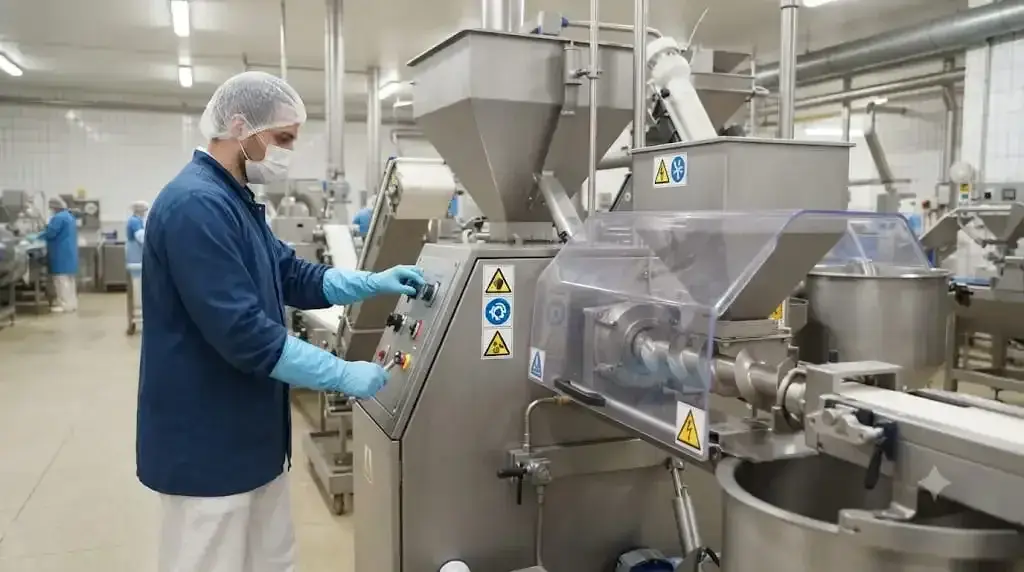
Teaching a new employee to work safely with a machine doesn't have to mean the production line grinds to a halt. By splitting the explanation, you can cover part of it in advance and practise the hands-on work at the line. The employee first gets to know the machine, the danger zones and the key safety rules. At the line, all that remains is demonstrating, practising and correcting.
Why is giving an explanation on a running production line so difficult?
A new employee can't simply start working on a machine. Working safely with machines starts with proper safety instruction covering the risks, and a clear work instruction for the correct way of working.
But where do you give that explanation? On a production floor, the line usually keeps running. It's loud, parts are moving, and the machine you're explaining is in use at that very moment.
A team leader trying to give an explanation next to a running machine has to keep an eye on production and on the employee receiving the explanation at the same time. Shouting over the noise, pointing out where a danger zone is and answering questions in between is hardly the calmest way to walk someone through a machine.
Looking at that same machine calmly beforehand, on a smartphone or tablet, gives a very different starting point.
Giving an explanation while the line is running costs time
In practice, there are several ways to teach a new employee how to operate a machine.
You stop the line for the explanation. The employee gets your full attention, but production stands still in the meantime. You give the explanation while the line keeps running. Production can continue, but the team leader has to fit the explanation in between tasks. That leaves less room to explain everything properly and to check understanding. Or you have an experienced employee guide the new colleague. That works well for the practical side, but the experienced employee can't fully focus on their own work at that moment.
A new employee obviously needs proper training. But not every explanation has to be given at a running production line. Part of it can be covered in advance, leaving more time at the line for practising and adjusting.
Not every team leader gives the same safety instruction
There's another point to consider: the explanation can differ from person to person.
One team leader talks at length about the danger zones. Another focuses mainly on the buttons and settings. What to do in the event of a fault, where you may and may not go, and when to stop the machine can therefore vary from one explanation to the next.
That makes it harder to give every new employee the same foundation.
Language can play a role too. When an employee doesn't speak Dutch fluently, it's important that safety instructions aren't just given, but genuinely understood.
A signature on a sign-off sheet shows that someone has received the safety instruction. It doesn't automatically mean they know what to do.
Get to know the machine first, before you start working with it
You don't have to wait until the employee is standing next to the machine to explain the basics. The safety instruction can largely be given in advance.
That's where the Skillcircle comes in. The Skillcircle by MetaChef consists of short 3D training modules for temporary and permanent employees. The training helps employees to better understand practical tasks and carry them out independently.
Before someone starts working with a machine, they can familiarise themselves in advance with its parts, the safety risks and the correct way of working. By viewing the machine in 3D, it becomes clear where parts are located and which actions matter.
The employee can follow the training on a smartphone, tablet or any other suitable device. A knowledge check can then verify whether the key information has been understood.
Language no longer has to depend entirely on the team leader either. The Skillcircle offers training in multiple languages and is also accessible to employees with low literacy.
That way, every employee gets the same basic explanation, regardless of who is on the floor that day.
The practical side is still learned at the machine
A 3D training module doesn't replace guidance on the production floor. The employee ultimately has to operate the machine themselves. A team leader or experienced colleague needs to be able to demonstrate, let them practise and correct on the spot.
The difference lies in the preparation.
The employee doesn't need to stand at the machine for every bit of basic explanation. The key information about the machine and the safety rules can be viewed and tested in advance.
At the line, the team leader can then focus on what can only be learned in practice: performing the task correctly, handling the real machine and responding to situations that arise during the work.
That makes the explanation not only more practical, but also prevents the full walkthrough from having to take place during production.
The Skillcircle is not a substitute for mandatory certification. Where a machine requires statutory or industry-specific certification, the designated course or certification remains necessary. A 3D training module can prepare and test knowledge, but does not issue a certificate itself.
A practical approach to working safely with machines
You can easily break this process down per machine:
1. Determine what someone needs to know
Note down the key safety rules, danger zones, emergency stop, faults and any other information someone must know before working with the machine.
2. Determine what someone needs to be able to do.
Distinguish between knowledge and actions. An employee can learn in advance where a danger zone is, but operating the machine ultimately has to be practised in real life.
3. Cover the basics in advance.
Use a fixed safety instruction that every employee can go through independently. A 3D training module can help explain the machine and the safety rules visually.
4. Use the time at the line for practice.
Have the team leader demonstrate, let the employee copy, and correct where needed. That way, you use the time at the production line for what genuinely needs to happen there.
5. Check that the employee understands.
A short knowledge check can verify whether the key information has stuck. Then observe at the line whether the employee performs the actions correctly as well.
That way, you don't have to choose between working safely with machines and a running production line. You move part of the explanation to a moment when the employee can learn calmly. At the line, more time remains for practising and coaching.
Seeing is understanding.
Want to know how to take the learn-in-advance approach beyond machines alone? Read more about onboarding new employees or browse all training modules within the Skillcircle.