Hazards in logistics training
A forklift reversing, a pallet of wet boxes high up in the racking, film on the walkway: in a warehouse, the hazards are in plain sight. Yet instruction often consists of yellow lines on the floor. Dutch health and safety law requires more: every employee must receive demonstrable instruction. For employers, that means two things: employees who spot hazards before something goes wrong, and proof that the instruction was provided.
Skillcircle's Hazards in logistics training delivers both. Employees see in 3D how to move safely between vehicles and racking. You can see who completed the training. Use the module on its own or as part of the complete onboarding and safety training in 3D.
Rules for hazards in logistics
Not a theory book, but the safety rules for the four situations where things go wrong, shown step by step:
Moving safely
Use the pedestrian door, not the high-speed door or roller door, and stay on the designated walkways and zebra crossings. Pedestrians have right of way unless indicated otherwise, but a driver who can't see you can't give way. So make eye contact before crossing, watch for the blue spot on the floor and never walk behind a moving or turning vehicle.
Preventing falling loads
Don't enter an aisle while a vehicle is working there, and never walk under raised forks or suspended loads. Keep your distance when stacking and unstacking, and watch out for unstable pallets, for example with wet boxes. Notice damaged racking? Report it immediately: damaged racking can collapse.
Safe working environment
Clear away waste straight away: wood, film and broken pallet parts. Report wet or slippery floors immediately, and take extra care at temperature transitions, such as at the door of a cold store or freezer: the floor can be slippery there.
Recognising hazards
A vehicle on the walkway, wet boxes in the racking, waste or a slippery floor: employees learn to recognise hazards in a realistic warehouse environment and know what to do when they spot one.
After completing the module, every employee will be able to apply the safety rules on the job. A knowledge check concludes the training. Don’t follow the rules for your boss, but for yourself: that’s the message that sticks.
Demonstrable for every audit
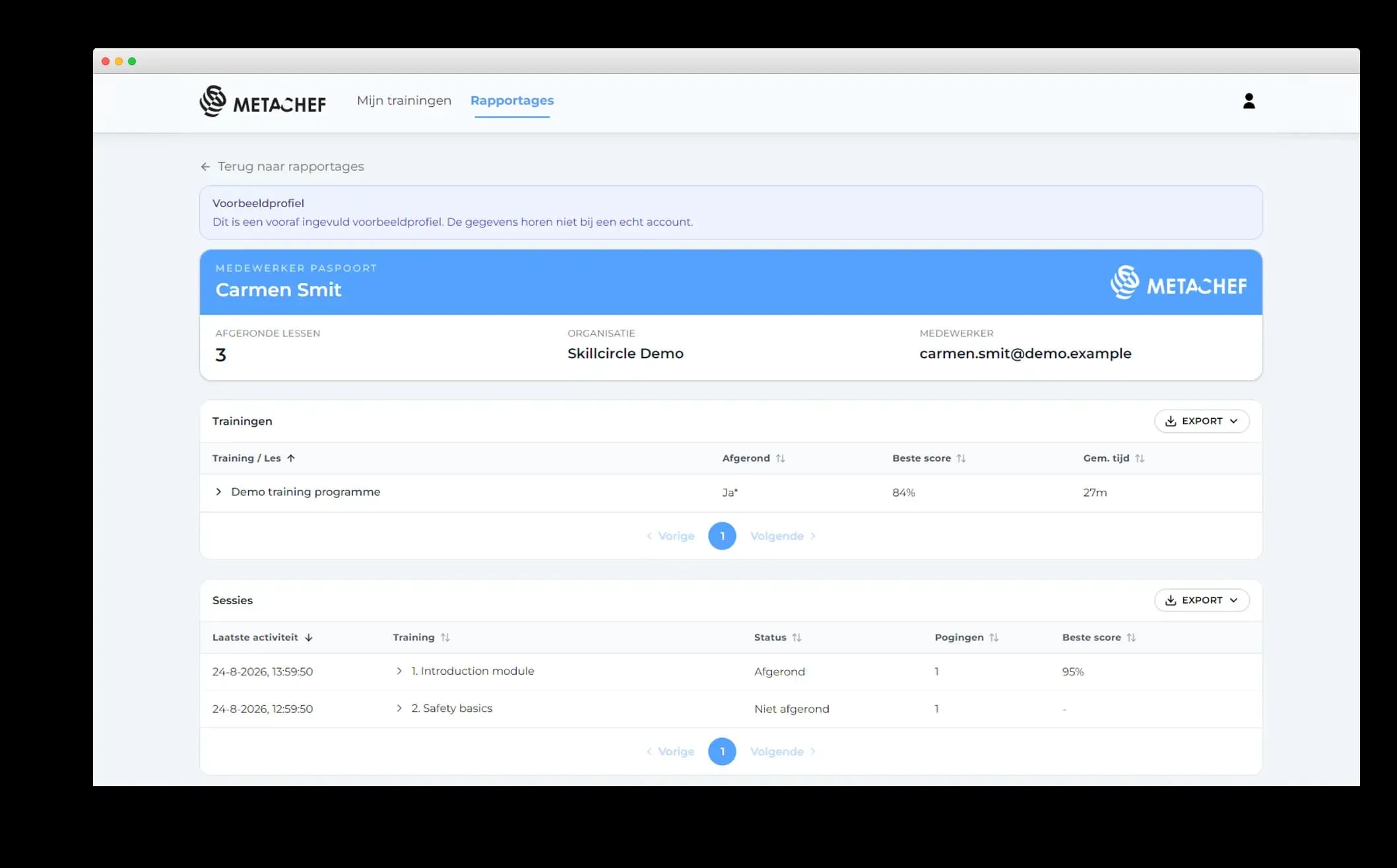
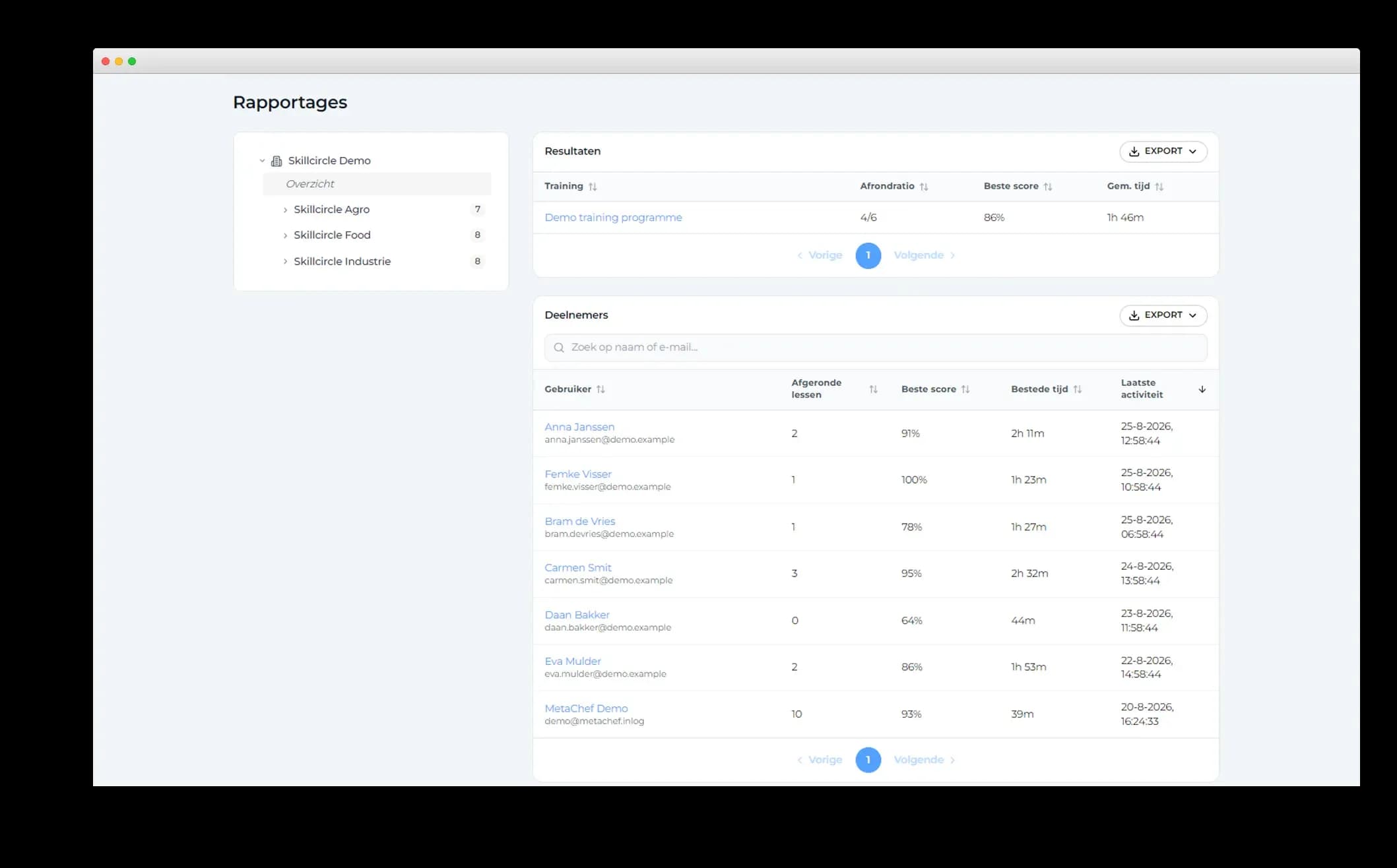
The MetaChef portal shows which training each employee completed, how much time they spent and their knowledge-check scores. Export reports as CSV or PDF, ready to use for the Dutch Labour Authority, risk-assessment follow-up or audits. This helps you fulfil the information obligation under Dutch health and safety law.
Multilingual hazards in logistics training on any phone
The training is fully mobile, with no computer, classroom or supervisor required. The multilingual instruction is accessible to employees with different language and literacy levels. The 3D visuals show what a warehouse really looks like, so the material is clear even for people with limited literacy. Temporary workers can even complete it before their first working day.
Do your employees also operate forklifts, reach trucks or pallet trucks themselves? Combine this module with visual 3D work instructions for safe use at the workplace itself.
Language support
Multilingual
For everyone
Suitable for limited reading skills
Fully mobile
No computer or classroom needed
Independent
No supervisor required
User analytics
Insight into each employee's progress
Standalone or modular
Combine exactly what fits





Start this week
Skillcircle is ready to go: in week one, we configure accounts and the connection to your HR or planning system; in week two, the first employees go live. From then on, you train continuously and repeat instruction where the data shows it is needed.
Week 1
Set up
Create accounts and set up the connection with HR or planning system.
Week 2
Go live
First employees go live.
Ongoing
Keep training
Repeat training for audits, new tasks or after incidents. Use data and feedback to make targeted adjustments.
See how it works
Book a demo and explore the Working at height training alongside the rest of the Skillcircle programme.

Frequently asked questions about hazards in logistics
Is safety instruction in the warehouse mandatory?
Yes. The Dutch Working Conditions Act (Article 8) requires employers to provide effective information about the risks of the work and the measures taken against them. In a warehouse, this includes traffic rules, walking routes and working near racking, as set out in your risk assessment. A certificate is not required, but demonstrable instruction is. This training provides that instruction and records the evidence for each employee.
How often should warehouse racking be inspected?
Under the European standard EN 15635, racking must be inspected by a qualified expert at least once a year. You also appoint a person responsible for the racking who carries out regular visual checks. But the most important check happens every day, by your employees: they are the first to notice a damaged upright or a bent beam. That's why this training teaches them to report any damage immediately.
What is a blue spot?
A blue spot is a blue light that a forklift or reach truck projects onto the floor in front of or behind it. This lets pedestrians see a vehicle coming before it appears around a corner or out of an aisle, even if they can't hear it. But a blue spot only works if everyone knows what it means. That's exactly why it's part of this training.
Does this training replace a forklift course?
No. A forklift course teaches drivers to drive safely. This training is for everyone who moves around the warehouse, such as order pickers, packers and cleaners who work on foot between the vehicles. They are the ones most at risk. The training is also useful for drivers: knowing how pedestrians should behave tells them what to watch out for.