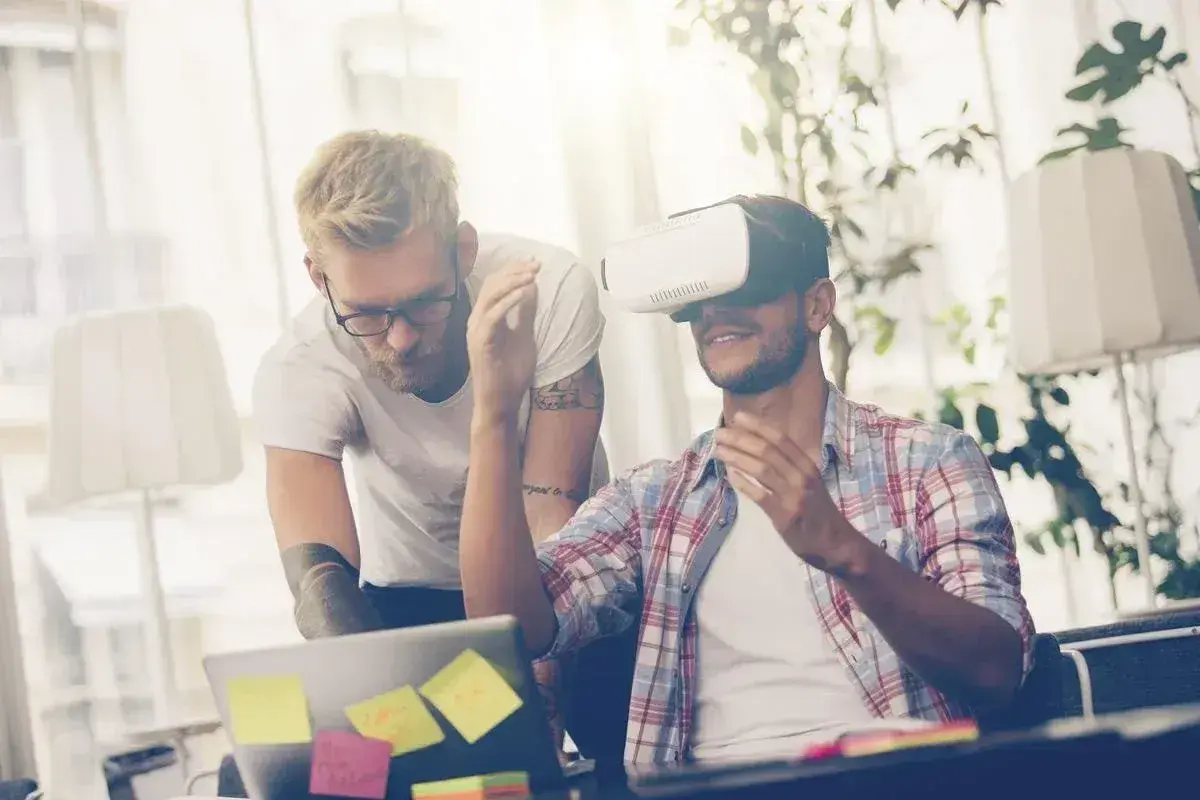
Learning practical skills is often challenging on multiple fronts. Some vocational training programmes require expensive or hard-to-obtain equipment. There are also often not enough materials for all students, giving them fewer practice opportunities and resulting in less efficient learning. Additionally, some practical lessons in real life at vocational training programmes involve safety risks. It is not always feasible to let many students into a factory for educational purposes. How do VR and 3D learning tools play a role in this?
What are 3D learning tools and VR environments?
A 3D model is a three-dimensional, interactive representation of an object. These 3D models can also be used in a virtual reality (VR) environment. This VR environment is built up from many different 3D models. By combining these technologies, realistic training environments can be developed for educational purposes. These interactive learning tools can be applied in vocational training programmes in sectors such as biology, food & technology, hospitality & catering, healthcare & health, and engineering. For example, it is possible to digitally recreate process steps within a factory, so that students can absorb this practical knowledge in a safe and efficient way.
Interactive learning tools in biology class
A good example of 3D learning tools in the educational sector is their use in biology class. Traditionally, students learn about the anatomy of the human body through books, images, and diagrams. But a 3D model of the human heart offers a much richer and more interactive learning experience. This helps visualise complex concepts and ensures that students become actively engaged with the subject matter. Students can study the heart from multiple angles by freely rotating it. This gives students a better understanding of how the circulatory system works and how the chambers of the heart function.
VR as a learning tool in production processes
Virtual Reality (VR) offers an innovative way to introduce students to complex production processes. In sectors such as the food industry, process technology, and logistics, VR can help create realistic and interactive learning experiences. Interactive learning tools offer students not only theoretical knowledge, but also practical insights that are more difficult to obtain in a physical environment. This contributes to a better understanding and depth of the production processes and prepares students for practice. In the engineering sector too, 3D models and VR are used to let students safely practise assembling machines or performing maintenance on electrical installations. This allows students to make mistakes without risks and practise repeatedly, which contributes to better preparation for practice. VR is therefore a powerful and future-proof learning tool that takes education to the next level.
Would you like to know how you can use 3D learning tools within your curriculum? Then visit our learning tools page and discover how MetaChef brings interactive learning to life.