Digital learning tools in education: what types are there?
Digital learning tools play an increasingly important role in education and practical training. Due to the rapid development of technologies, many tools and platforms are now available that make learning more interactive, accessible, and efficient. But what types of digital learning tools are there exactly? And how do they contribute to modern education?
E-learning platforms
E-learning platforms offer complete online courses with interactive modules, quizzes, and certification. These digital learning tools enable flexible learning and are suitable for both students and professionals. Organisations often use e-learning platforms to offer a wide range of development opportunities, allowing learners to work independently on their skills.
Additionally, e-learning platforms provide a learning experience that aligns with the individual needs of the user. Students are not bound to fixed times or locations and can learn where and when it suits them.
Interactive assignments
Interactive assignments consist of short, clear lessons that are easy to integrate into virtually any form of education. Due to their interactive nature, students engage more actively with the subject matter than with traditional teaching methods. Animations, videos, and interactive quizzes create more engagement and help students better understand and remember the material. This results in deeper knowledge and a more effective learning experience.
Virtual Reality and Augmented Reality learning tools
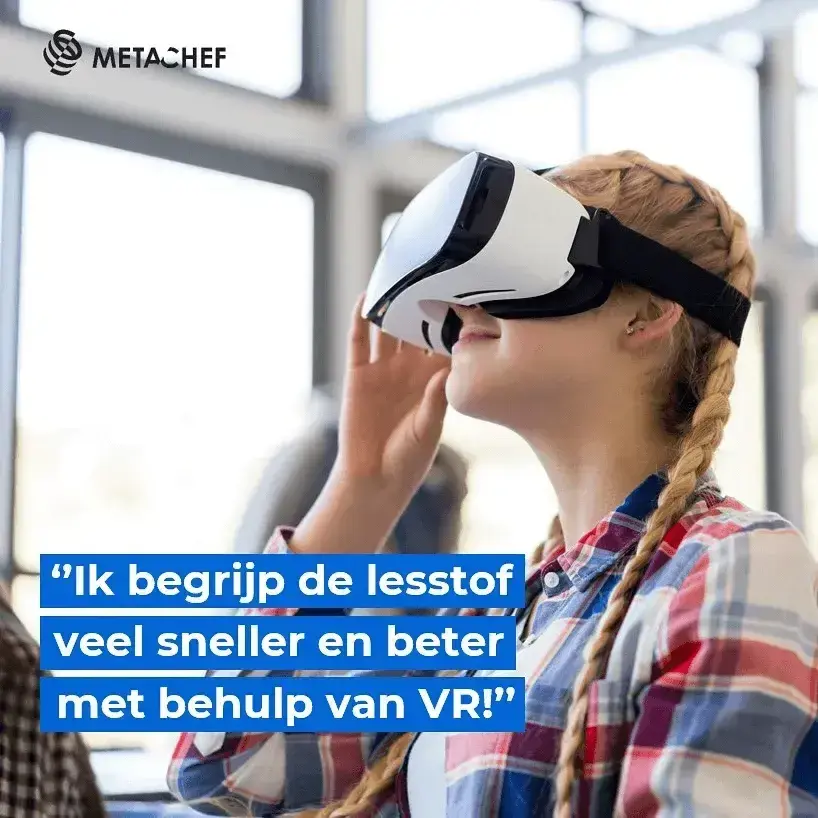
Virtual Reality (VR) and Augmented Reality (AR) make it possible to simulate learning experiences in a virtual or enriched environment. These technologies are primarily used in medical training, technical education, and practice-oriented learning.
With VR, realistic training and practical situations can be simulated. For example, students can practise process steps within a production factory without the risks of a real working environment. This makes learning safer and more efficient.
AR adds digital elements to the real world. With the help of AR, 3D models can be projected directly from a book or screen. This is particularly valuable in subjects such as anatomy, mathematics, and chemistry, where abstract concepts are often difficult to visualise. Students can view objects from different perspectives, leading to a better understanding of the subject matter.
Interactive 3D models
Interactive 3D models are an accessible and effective way to enrich education with digital learning tools. By visually representing complex concepts, they increase students' understanding and engagement. With these interactive learning tools, teachers can easily integrate 3D models into their lessons, allowing students to study objects from multiple angles.
In combination with blended learning and online education, interactive 3D models offer a way to maintain practical learning, even remotely. Students gain access to the learning material via their own devices, which provides more flexibility and accessibility.
Gamification in education
Gamification is the application of game elements in a non-game environment. In education, gamification is increasingly being used to make learning processes more enjoyable and motivating. Think of point systems, rewards, and competition elements that encourage students to actively participate in the lesson.
Research analysing 120 academic studies between 2011 and 2014 shows that gamification is being applied more broadly and is better defined as an effective strategy within digital learning tools (Caponetto, Earp & Ott, 2014).
Well-known platforms such as Kahoot! and Duolingo demonstrate how game elements increase student motivation and engagement. By integrating challenges and rewards, a more active and attractive learning process is created.
Reference: Caponetto, I., Earp, J., & Ott, M. (2014, October). Gamification and education: A literature review. In European Conference on Games Based Learning (Vol. 1, p. 50). Academic Conferences International Limited.